2026 · Released
G4man Studio
Our first product was ourselves.
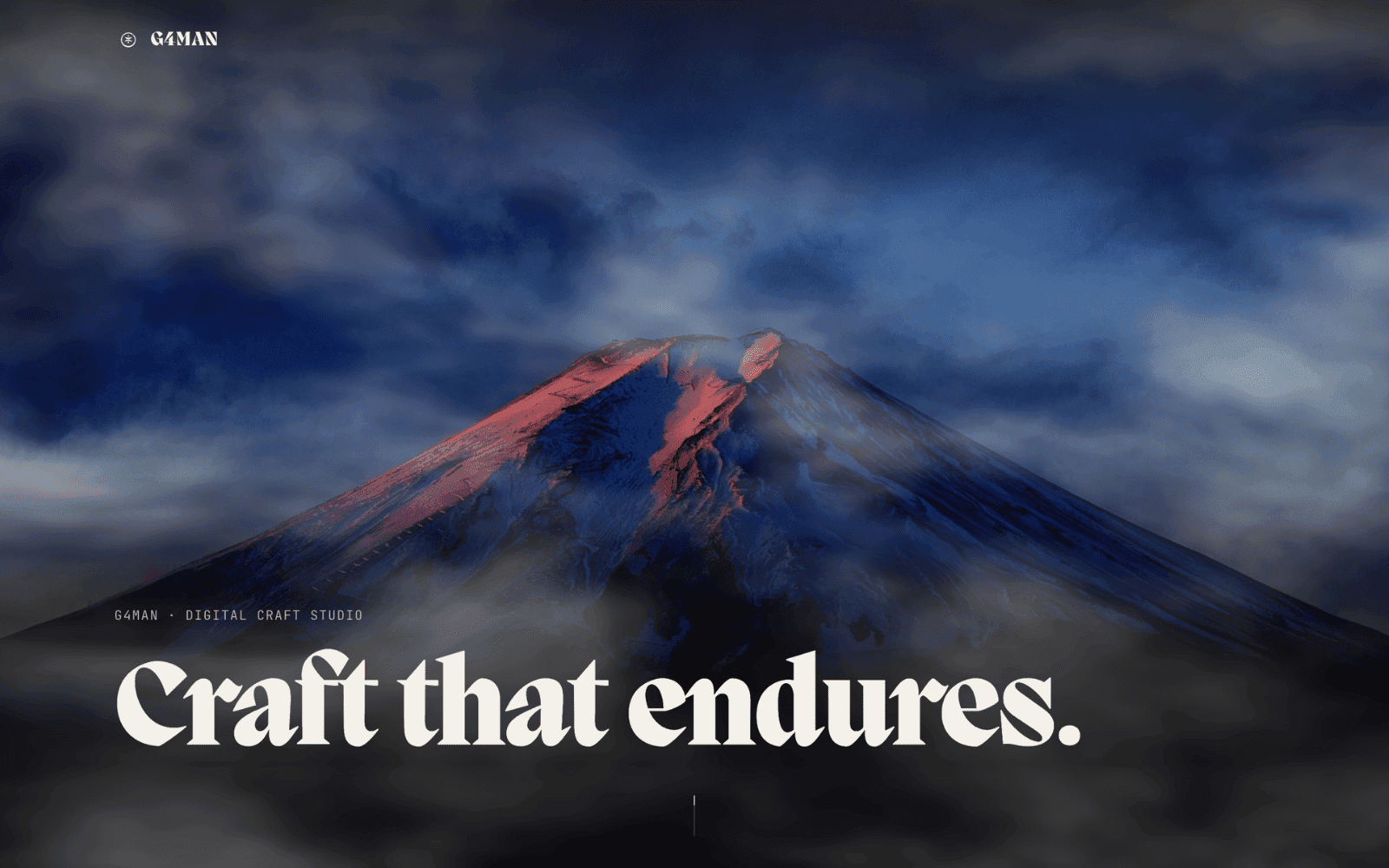
Our own project
Identity & site
Before Machi, before the first client, the first product we built on our philosophy was the brand itself: the identity, the system, and the site you're reading right now.
This isn't a brochure about us. It's proof that the discipline we bring to a client's work starts at home. If we build our own identity with this much care, that's how we'll build yours.
This case study shows the seams — the decisions, the tools, the system underneath. The /studio page hides the scaffolding on purpose; here, we show it off.
One image, stitched end to end
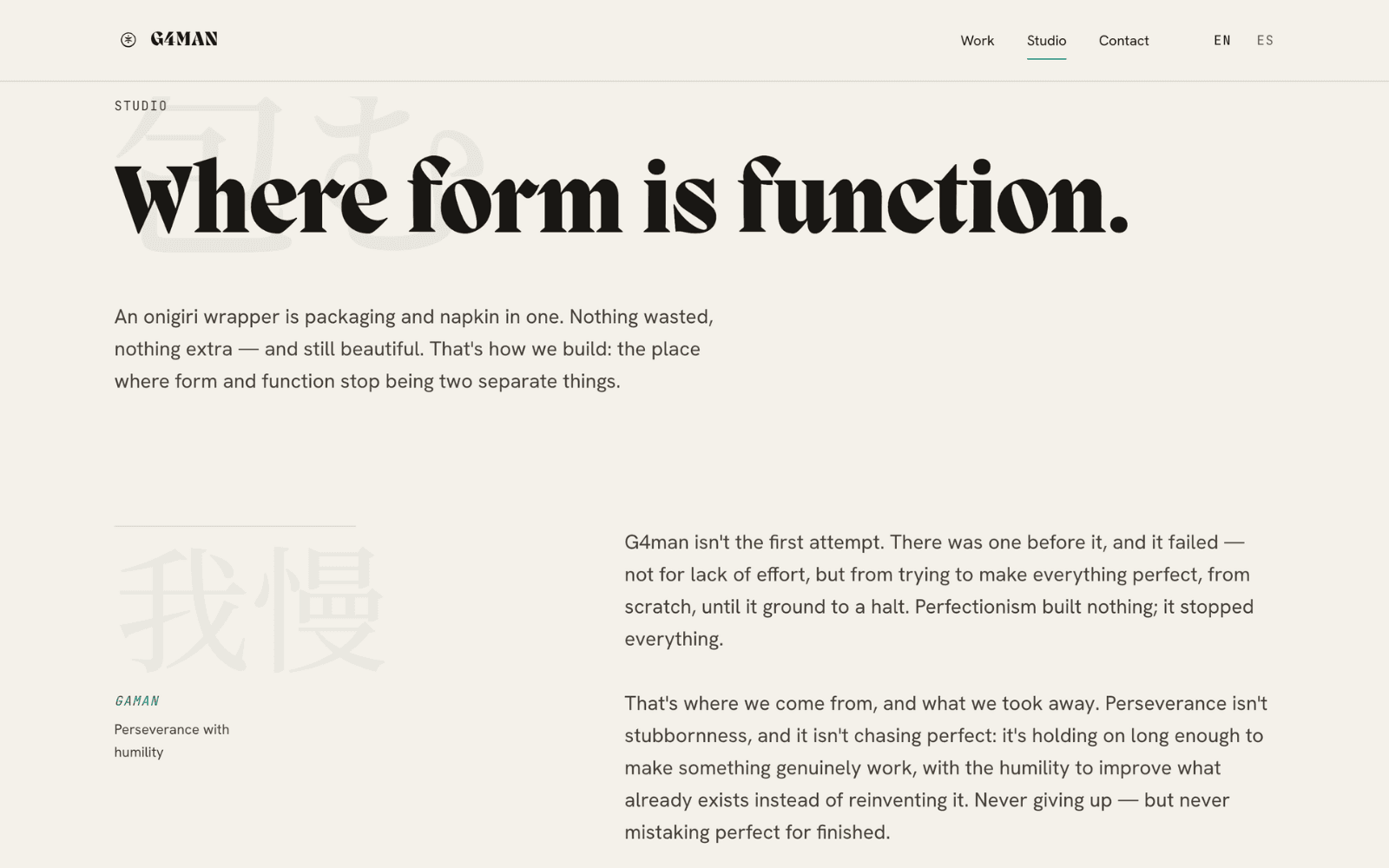
The whole identity hangs on a single image: an onigiri wrapper. Packaging and napkin at once — one sheet, two purposes, nothing extra, and beautiful all the same.
That image folds the three pillars into an everyday gesture. The patience to fold it right, because a sloppy fold falls apart: that's gaman. Not one crease too many, the sheet clean and exact: that's takumi. One sheet, two jobs: that's mottainai.
On the /studio page this image is named outright only twice — at the open and at the close — and quietly governs everything between. Repeating "like the wrapper…" in every line would betray mottainai itself. The reader feels the coherence without our spelling it out.
Every decision is evidence of a pillar
The site doesn't describe how we work: it is how we work. Every visual decision carries a reason.
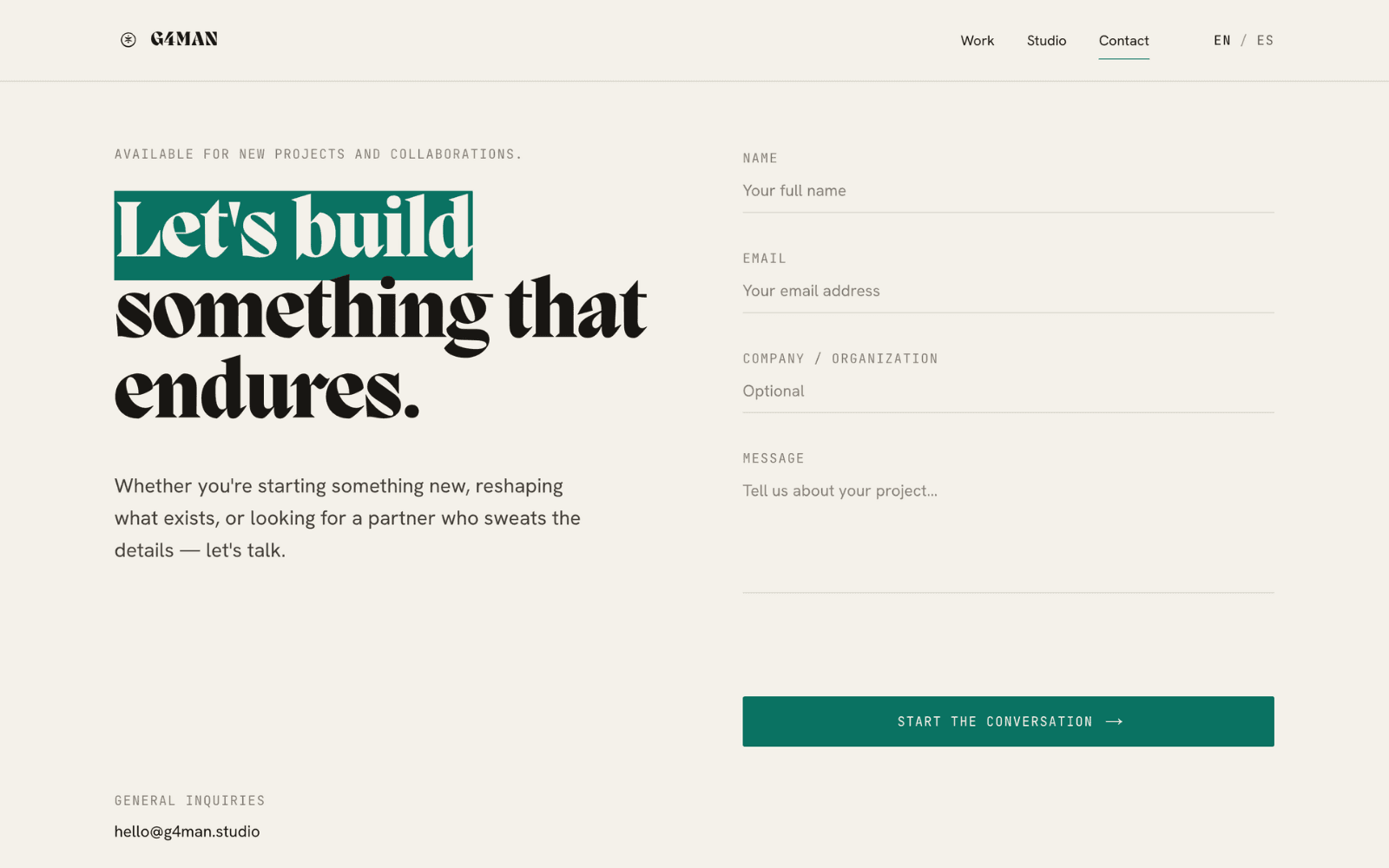
The background isn't black.
Black would have been the easy, well-worn move — the shortcut every portfolio takes. We chose jade and clean, bright, luminous neutrals: an echo of traditional Japanese sensibility, simple and clear. Not taking the shortcut is gaman.
There's no red.
Error states use the weight of ink, not red. An honest note: red wasn't removed as a crusade. When we set the palette it simply never showed up, and we kept it that way as part of the identity. We won't dress it up as an obsession it never was — that would be faking craft, the very opposite of takumi.
Jade as a rare accent.
Jade isn't ambient: it's an event. It appears on hover, on focus, on the active state, on success — the moments where something happens. A color that earns its entrance carries more weight than one that's everywhere.
Only the sections that earn their place.
Just what's needed, no parts to spare. The "how we work" section was cut because the pillars already said it. Removing the redundant is mottainai at the structural level.
Simple on the surface, robust underneath.
The principle behind the whole brand, proven in the contact form: ordinary at a glance — name, email, message. Underneath: a honeypot, anti-bot validation verified server-side, rate limiting, DNS configured with care. Simple without being careless, robust without showing off.
強輝
The finest seam
Proof that the concept isn't decoration: the Japanese feudal structure reaches all the way down to the most operational, most boring detail in the business — the email addresses. It isn't a layer of branding on top; it's the system itself, instanced where almost no one would bother to look.
Era Kyōki isn't about who rules whom — it's about which force serves which function. 強輝 is strength plus brilliance: two qualities, never a ladder.
天皇 tennō — decides and represents. The vision, the voice, the front.
奉行 bugyō — executes and maintains. The operations, the infrastructure, the machinery that holds it all up.
[email protected] is the tennō: the founding, creative identity. It signs proposals and speaks to clients as "the studio".
[email protected] is the bugyō kanjō (奉行勘定, magistrate of finance): operations, billing, infrastructure. It uses plus-addressing — +resend, +stripe, and so on — to filter each service. Mottainai applied to the inbox: one address, many jobs.
bugyō isn't a rung on the warrior ladder but an administrative office in the feudal bureaucracy. It's deliberate, and more exact than daimyō for "finance and operations": the daimyō governed land; the bugyō administered.
The chisel doesn't decide where to cut
The uncomfortable question first: can you talk about craft if the site was built with modern tools and artificial intelligence? We think that question mistakes the tool for the craft.
A carver today doesn't work the wood with their fingernails out of nostalgia. They use the best chisel there is. But no chisel — however sharp — decides where the cut goes. That decision belongs to the hand holding it, and that's where craft lives. Craft was never about refusing the good tool; it was about the judgment that guides it.
That's how we work. We neither hide the tools nor flaunt them as if they did the work.
How it was made
We started with the concept, not the screen. The wrapper, the three pillars, the thesis that form and function are one and the same — all of it existed in words before a single pixel did.
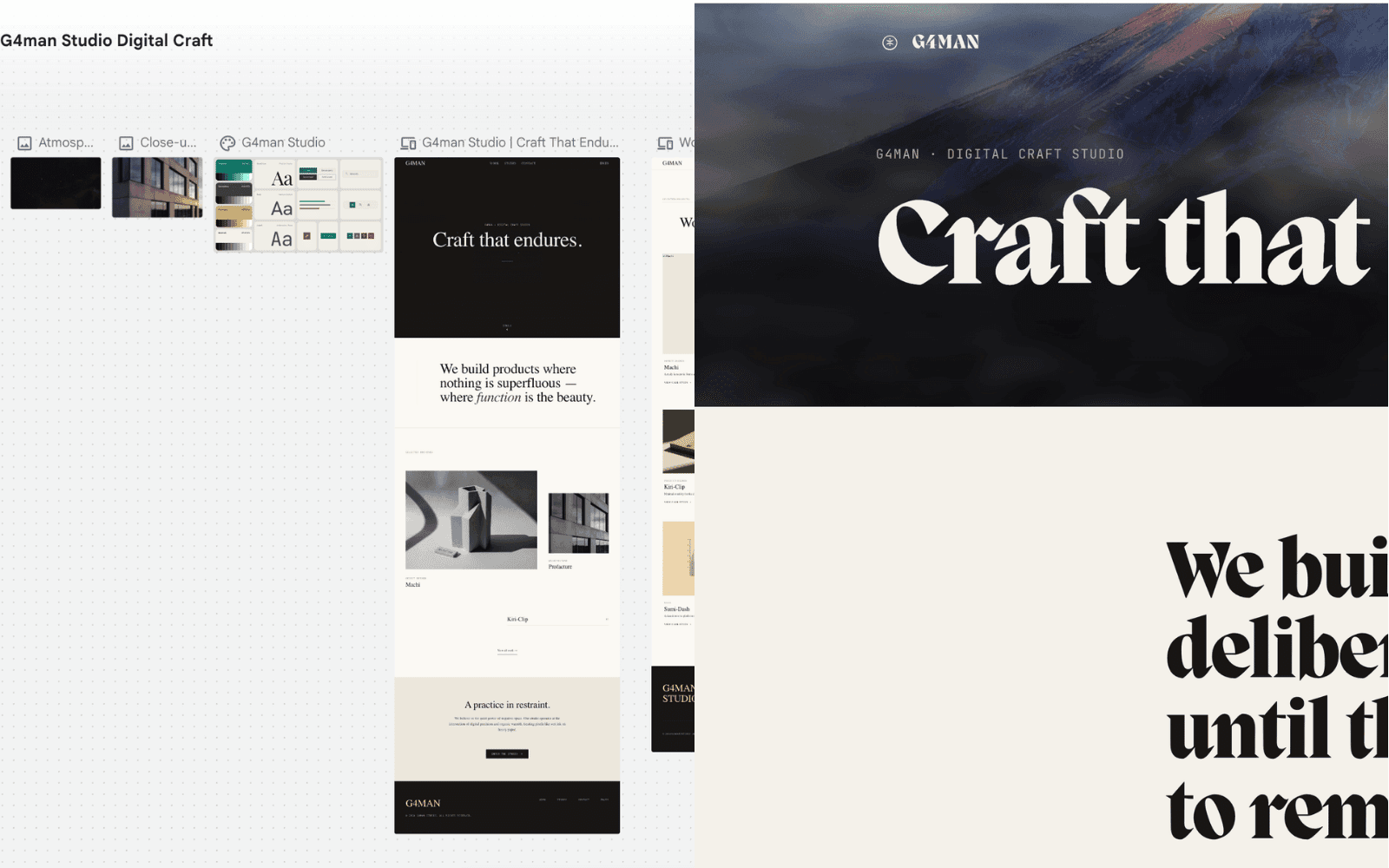
With the concept settled, we used Stitch to see form fast: to explore composition and first screens with the eyes, not in the head. Decide by what's on screen, drop early what doesn't work. From there we distilled a single design document — one source of truth for color, type, and rhythm — and built the site on that foundation.
Artificial intelligence was a judgment copilot the whole way: architecture, copy, review, drafting the instructions that guided the build. It didn't make the decisions — it accelerated them. The difference between using a tool and letting the tool use you is exactly that, and it can't be outsourced.
Where the craft showed
The site was tuned by iterating against screenshots, adjusting by eye until each detail felt right — the fold of the hero, the weight of a title, the exact moment jade appears. Some effects we chased for whole rounds and let go once we recognized they needed a different workshop; they're noted for a second version instead of blocking the first. That was work too: knowing when to keep folding and when to accept that the sheet, for today, already holds.
Gaman in not giving up on the detail. Takumi in admitting the crease that still doesn't sit right, and folding again. Mottainai in not wasting effort chasing what wasn't due yet. The pillars didn't stay on the /studio page — they governed how it was made, too.
The proof
Every decision in this project passed through the three pillars. Jade instead of the easy black. Only the sections that earn their place. A form simple on the surface and robust underneath. An identity that reaches all the way down to the email. What you see doesn't describe how we work — it is how we work.
And like any well-folded wrapper, it holds two forces at once: tennō, which decides and represents, and bugyō, which executes and maintains. Vision and operation. Neither rules the other — each fulfills its function. That's 強輝: strength and brilliance, two qualities, never a ladder.
If we build ourselves with this discipline, that's how we build yours.